Cart

X Image

{{item.name}}

${{item.price.price}}

Total

${{totalPrice}}

.

{{ctatext}}

or Continue Shopping

Your cart is empty

Continue Shopping

{{promoModalTitle}}

Close Image

2026-10-21 06:06:48

Do You Need to Fast Before Blood Work? A Test-by-Test Guide

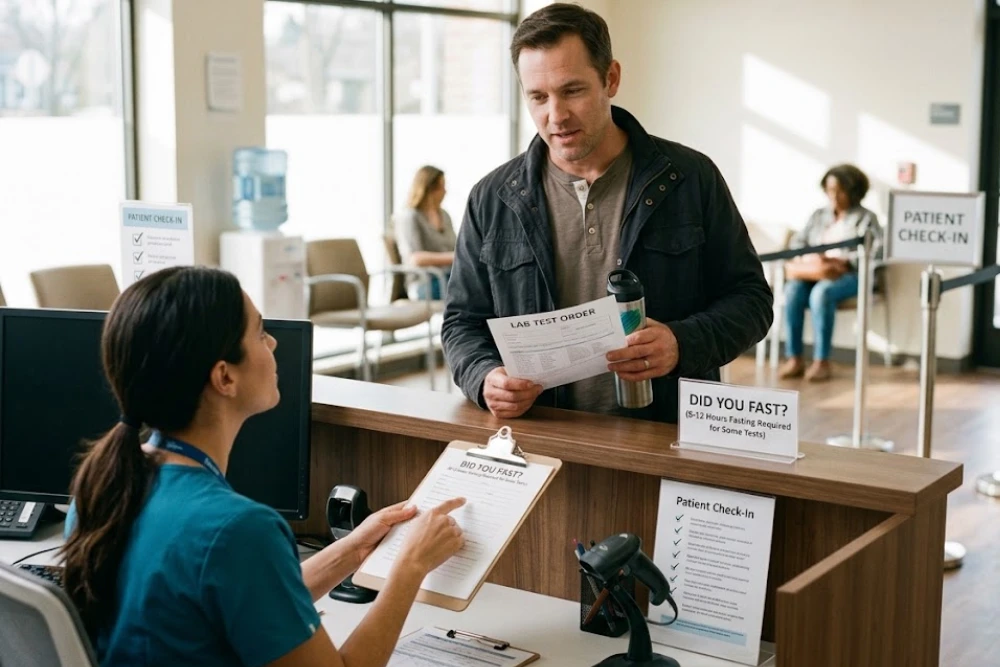
You've ordered your lab work, and now you're wondering if you can have breakfast first. The short answer is: it depends on the test. Some blood tests are affected by what you eat. Many others are not.

In this blog, we'll cover why fasting matters for some tests, which common tests usually require it, what "fasting" actually means, and what to do if you slip up.

Why Some Tests Require Fasting

When you eat, your body breaks food down and sends sugar, fats, and other nutrients into your bloodstream. For a few hours after a meal, your blood looks different than it does on an empty stomach.

For most tests, that doesn't matter. But for tests that measure sugar and fats directly, a recent meal can push your results higher than your true baseline. Fasting gives the lab a clean, consistent snapshot so your results can be compared fairly to the reference range and to your past results.

What "Fasting" Actually Means

Fasting for blood work usually means nothing to eat or drink except water for a set number of hours before your draw, most often 8 to 12 hours. That includes:

Plain water is fine and encouraged. Staying hydrated makes your veins easier to find and your draw quicker.

Most people find it easiest to schedule a morning appointment and fast overnight. If you stop eating after dinner and get your blood drawn first thing in the morning, most of your fasting time happens while you sleep.

Tests That Often Require Fasting

These are the most common tests where fasting may be required. Always follow the instructions that come with your specific order, since requirements can vary.

Tests That Usually Don't Require Fasting

Many common tests are not affected by food. These generally don't need fasting:

What About Medications?

In most cases, keep taking your regular medications as prescribed, even on a fasting day. Skipping a needed medication can cause problems of its own. If you take medication for diabetes, talk to your provider before fasting, since going without food while on certain diabetes medications can drop your blood sugar too low.

If you take a high-dose biotin supplement, ask your provider whether you should pause it before testing, because biotin can interfere with some lab results.

What If You Accidentally Ate?

It happens. You grabbed a coffee on autopilot or forgot and had a granola bar. Here's what to do:

Tips for an Easier Fasting Draw

Order Your Tests With eNational Testing

eNational Testing makes it simple to order lab tests online and visit a collection site near you. Each order comes with instructions for your specific tests, including whether you need to fast. 

Browse metabolic, heart, diabetes, thyroid, and wellness panels at enationaltesting.com, or call 866-766-1631 with questions.